

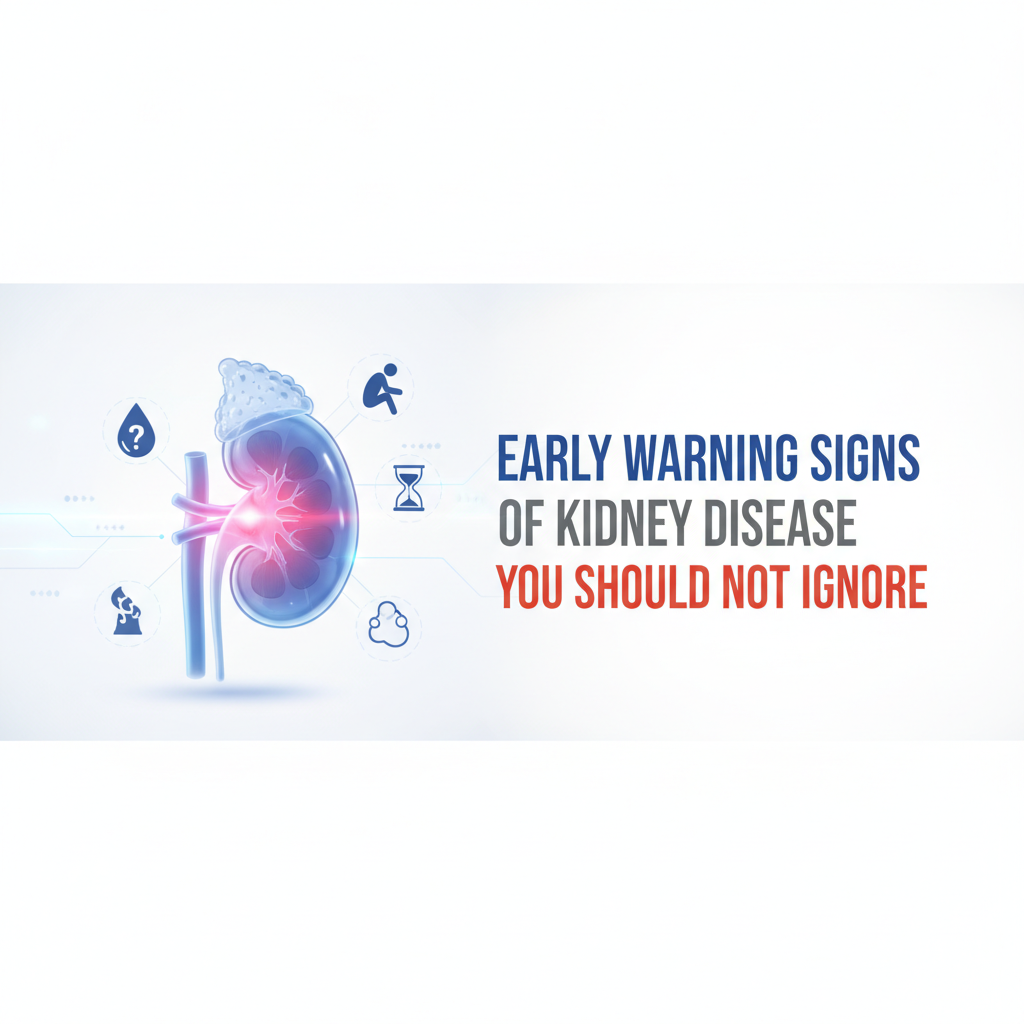
TL;DR: Early kidney disease seldom hurts, so the warning signs are faint ones: foamy or blood-tinged urine, fresh night-time trips to the toilet, puffiness around the eyes or ankles, blood pressure that refuses to settle, and fatigue or itching with no obvious cause. Two cheap tests settle most cases: serum creatinine with eGFR, and a urine albumin-to-creatinine ratio. A General Physician in Bangalore at Al Ansaar Hospital Bangalore, a leading Multispeciality Hospital in Bangalore, can order both.
Abnormal results must hold beyond three months before anyone diagnoses chronic kidney disease.
Key takeaways
- Kidneys can lose most of their function before a single symptom shows up; the CDC estimates that about 9 in 10 US adults with CKD have no idea.
- Foamy urine that lingers, visible blood, new night-time urination, swollen eyelids in the morning and hypertension that resists treatment are the signs most closely tied to the kidneys.
- A normal creatinine does not rule out early disease. Ask for eGFR and a urine albumin-to-creatinine ratio (ACR) as well.
- If you live with diabetes, hypertension, heart disease or a regular painkiller habit, get screened every year, symptoms or not.
- Barely any urine for 12 hours, confusion, chest pain, or breathlessness together with swelling means emergency care the same day.
- CKD is confirmed only when abnormalities last over three months, so one result begins a process instead of closing it.
Table of contents
- What are the early warning signs of kidney disease?
- Why does kidney disease go unnoticed for so long?
- Which symptoms should you take seriously first?
- Which symptoms point to the kidneys and which do not?
- Who should be screened even without symptoms?
- Which tests confirm kidney disease at a diagnostic centre in Bangalore?
- When is it an emergency? Choosing an emergency hospital in Bangalore
What are the early warning signs of kidney disease?
The early warning signs are small shifts in urine, swelling, blood pressure, energy and skin. They point to falling filtration or protein leaking through, often well before blood tests look alarming. For adults with diabetes, hypertension or a family history, even a minor-looking sign earns a kidney check.
By the KDIGO definition, chronic kidney disease (CKD) is abnormal kidney structure or function that lasts more than three months. In day-to-day terms, that means an eGFR below 60 mL/min/1.73 m² or a marker of damage, most often albumin in the urine.
This guide is written for adults and families searching for a hospital near me in Bangalore who are trying to decide which tests to request, which doctor to visit first and how urgent a symptom really is. It also covers what the best healthcare services in Bangalore ought to provide before you commit to treatment.
Why does kidney disease go unnoticed for so long?
Each kidney holds around a million filtering units, and the healthy ones work harder to cover for the damaged ones. That is why the disease hides. Symptoms often arrive only after function has dropped well below half, by which point the damage is usually permanent.
The CDC, 2024 estimates that about 1 in 7 US adults has CKD and that some 9 in 10 of them are unaware of it. The mechanism is the same everywhere. Many diagnoses start with a routine health check at an affordable hospital in Bangalore, not with a symptom.
Creatinine on its own makes matters worse. It can sit comfortably inside the lab’s reference range while eGFR has already slipped, especially in older adults or people with low muscle mass, and albumin can seep into urine for years before creatinine budges at all.
Which symptoms should you take seriously first?
Start with urine changes, swelling and blood pressure, since they tie most directly to the kidneys. Fatigue, itching and a poor appetite are real but vague, so they count mostly when they cluster with those signs or with risk factors such as diabetes.
Urine changes: foam, color, frequency and volume
Foam that is still sitting there after you flush can mean albumin is leaking into the urine. One frothy morning after a fast stream is usually harmless. Foam every day for two weeks is another matter.
Pink, red, tea-colored or cola-colored urine needs evaluation within days. Stones, infection, glomerular disease and tumors all cause it, and you cannot tell them apart at home.
Getting up two or more times a night is a newer pattern worth noting, because failing kidneys concentrate urine poorly. Diabetes, an enlarged prostate and sleep apnea cause it too, which is why consulting specialist doctors in Bangalore helps sort it out.
Swelling: eyelids in the morning, ankles by evening
Puffy eyelids on waking and swollen ankles by evening suggest the body is holding on to sodium and water. Press a thumb into the shin for five seconds; a dent that lingers is pitting edema. Heart failure, liver disease, venous problems and drugs such as amlodipine produce the same sign, so swelling calls for a urine test and evaluation at a cardiology hospital in Bangalore.
Blood pressure that will not behave
Hypertension damages kidneys, and kidney disease pushes blood pressure up, so the loop is hard to read from the outside. Suspicion grows when hypertension begins before 40, needs three or more drugs, or climbs for no clear reason. A week of home readings shared with a general medicine hospital tells the doctor more than a single clinic measurement.
Fatigue, itching, taste changes and cramps
Failing kidneys make less erythropoietin, so anemia brings tiredness and breathlessness on the stairs. Built-up waste shows itself as itch without a rash, a metallic taste, nausea, night cramps and restless legs. These usually turn up at moderate to advanced stages, so treat them as late signals.
Illustrative example: A 52-year-old software manager with eight years of type 2 diabetes consults the best doctors in Bangalore after waking twice a night and noticing ankle swelling after long workdays. His annual check shows creatinine of 1.3 mg/dL, flagged as borderline.
Follow-up testing gives an eGFR near 66 and a urine ACR of 220 mg/g, which means stage G2 with moderately increased albuminuria. It was the urine test, not the creatinine, that changed his treatment.
Which symptoms point to the kidneys and which do not?
A symptom points to the kidneys when it involves urine, fluid retention or blood pressure and shows up alongside risk factors. Back pain, tiredness and headache by themselves rarely do. The table ranks common complaints by how strongly they suggest the kidneys are involved and what to do next.
| Symptom | Kidney link | Other common causes | Next step |
|---|---|---|---|
| Foamy urine that persists | Strong (albuminuria) | Concentrated urine, forceful stream | Urine ACR within 1–2 weeks |
| Visible blood in urine | Strong | Stones, infection, prostate, tumor | See a doctor within days; urgent if clots or retention |
| Waking 2+ times to urinate | Moderate | Diabetes, prostate, sleep apnea, evening fluids | Urine, creatinine and glucose tests |
| Puffy eyelids on waking | Moderate to strong | Allergy, poor sleep, thyroid | Urine test and blood pressure check |
| Ankle swelling | Moderate | Heart, liver, veins, drugs, long sitting | Urine, creatinine and heart assessment |
| Persistent itch, no rash | Moderate, later stages | Dry skin, allergy, liver disease | eGFR and liver tests |
| Flank or back pain | Weak for CKD; strong for stones and infection | Muscle strain, spine problems | Same day if fever or severe colic |
Pain is a poor guide. CKD is usually painless, while stones and kidney infections hurt, so having no pain gives you no comfort at all.
Who should be screened even without symptoms?
Adults with diabetes, hypertension, heart disease, or family risk seeking the best medical treatment in Bangalore should have eGFR and urine ACR checked at least once a year. The NIDDK names diabetes and high blood pressure as the leading causes of kidney failure.
- Type 2 diabetes from the day of diagnosis; type 1 diabetes after five years
- Hypertension of any duration
- Heart failure or coronary disease
- A parent or sibling with kidney failure
- Preeclampsia in a past pregnancy
- Recurrent kidney stones, urinary infections or prostate enlargement
- Frequent diclofenac, ibuprofen or etoricoxib for joint or back pain
- Age above 60, smoking or obesity
Look closely at what your corporate health package actually contains. Many report serum creatinine and a routine urine dipstick but leave out ACR, which means early albumin leakage can slip past for years.
Which tests confirm kidney disease at a diagnostic centre in Bangalore?
Three results carry most of the load: serum creatinine converted to eGFR, a urine albumin-to-creatinine ratio, and urinalysis with microscopy. Ultrasound and blood pressure add context. Any diagnostic centre in Bangalore offering Al Ansaar Healthcare Services can run these; what matters is repeating abnormal results after three months.
| Test | What it shows | What flags a problem | Limitation |
|---|---|---|---|
| Serum creatinine and eGFR | Estimated filtration | eGFR below 60 mL/min/1.73 m² | Muscle mass, creatine supplements and a large cooked-meat meal shift creatinine |
| Urine ACR | Albumin leakage | 30 mg/g or higher | Fever, hard exercise and infection raise it temporarily |
| Urinalysis with microscopy | Blood, protein, casts, infection | Red cells, casts, persistent protein | Dipsticks miss small albumin amounts |
| Kidney ultrasound | Size, scarring, obstruction, stones | Small shrunken kidneys, hydronephrosis | A normal scan does not exclude early disease |
| Cystatin C | Alternative filtration marker | Clarifies borderline eGFR | Not routine at every lab |
| Hemoglobin, potassium, bicarbonate | Complications | Anemia, high potassium, low bicarbonate | Usually abnormal only in later stages |
How to read eGFR and ACR results
KDIGO grades eGFR as G1 (90 or above), G2 (60–89), G3a (45–59), G3b (30–44), G4 (15–29) and G5 (below 15). Albuminuria runs A1 (ACR under 30 mg/g), A2 (30–300) and A3 (above 300). Risk depends on the pairing, so G2 with A3 carries more danger than G3a with A1.
Preparing for the tests
Give a first-morning urine sample, skip hard exercise for 24 hours, and postpone if you have a fever or a urinary infection. Mention any creatine or protein supplements to the lab. One abnormal result is a reason to repeat the test.
It is not a reason to panic.
When is it an emergency? Choosing an emergency hospital in Bangalore
Head to an emergency hospital in Bangalore or a 24 hours hospital in Bangalore the same day if you pass very little or no urine for 12 hours, or if you develop breathlessness with swelling, confusion, chest pain, palpitations, seizures, or fever with flank pain and chills. Acute kidney injury and high potassium can turn dangerous within hours.
Acute kidney injury (AKI) is not the same as CKD. It builds over hours to days, often after dehydration, infection, urinary obstruction or a drug, and it frequently reverses when treated early.
Potassium is the quiet danger. When failing kidneys cannot clear it, it can disturb the heart’s rhythm, so an ECG and a stat potassium belong in the first minutes of assessment.
What a capable emergency unit does first
- Records an ECG and checks vital signs
- Runs potassium, creatinine, bicarbonate and glucose urgently
- Uses a bladder scan or ultrasound to rule out obstruction
- Reviews and stops harmful medicines
- Decides on fluids, monitoring and whether nephrology or dialysis input is needed