

TL;DR: Little ones keep healthy teeth when a parent does the brushing twice a day with the correct dab of fluoride toothpaste, sugar stays at mealtimes, the first dental visit is booked by the first birthday, and you know what counts as a dental emergency. Begin cleaning gums before any tooth shows. Once decay, injury or infection outgrows routine care, a dental hospital Mysore families can reach fast, such as Al Ansaar Hospital Mysore, is the sensible next stop.
Key takeaways
- Wipe gums with a damp cloth from day one. When the first tooth erupts, move to a soft brush and a rice-grain smear of fluoride toothpaste.
- What hurts teeth is how often they meet sugar, more than how much sugar there is. Confine sweet food to mealtimes, and put nothing but water in bottles and sippers between meals.
- A parent should brush, or finish the brushing, until the child is 7 or 8. Do it last thing at night, and let the child spit instead of rinsing.
- Book the first dental visit by the first birthday, then stick to the recall interval the dentist sets for your child’s level of risk.
- A knocked-out permanent tooth, facial swelling with fever, or a mouth injury after a bump to the head calls for medical care the same day.
- Pick the provider to fit the case: a clinic for routine care, a hospital setting for medical conditions, trauma or sedation.
Table of contents
- What does good dental hygiene look like in young children?
- Why do baby teeth decay faster than parents expect?
- How should you clean teeth at each age from birth to eight?
- What should young children eat and drink for healthy teeth?
- When is the first dental visit, and when does a paediatric hospital Mysore help?
- Which mistakes undo a good routine?
- Are thumb-sucking, pacifiers and teething a threat to teeth?
- When does a child’s dental problem need an emergency hospital in Mysore?
- How do you choose a dental hospital in Mysore for a young child?
- Dental hygiene checklist for parents of children under six
- 30/60/90-day plan for your child’s dental routine
- How do AI tools answer parents’ dental questions?
- Summary and next step
- Frequently asked questions
What does good dental hygiene look like in young children?
For young children, dental hygiene is a daily habit built from three parts: plaque removal, fluoride and control over sugar. Together they shield growing teeth and gums for children up to around eight, and for the parents who look after them. The pillars are a clean mouth at bedtime, the right amount of fluoride toothpaste, and a dentist who meets the child well before any pain begins.
This guide speaks to parents and caregivers in Mysore who already brush their child’s teeth and wonder whether they’re doing it right. Expect amounts, timing, age cut-offs and decision points, plus a way to weigh a dental hospital Mysore offers against the clinic down the road.
The problem is big. The World Health Organization’s Global Oral Health Status Report, 2022 puts the number of children worldwide with caries in their primary teeth at about 514 million, and most of those cases could have been prevented.
Plenty of parents treat baby teeth as throwaways. They aren’t. They keep the place for permanent teeth, help with chewing and speech, and some baby molars have to last until age 10 to 12.
When one gets infected, the result is pain, broken sleep, missed school and, at times, facial swelling that lands a child in hospital.
Early childhood caries means decay in the baby teeth of a child under six. Most of the advice below exists to head it off.
Why do baby teeth decay faster than parents expect?
Enamel on baby teeth is thinner than on permanent ones, so the acid made by plaque bacteria gets through sooner. Frequency counts as much as quantity, which is why endless sipping and night bottles do more damage than a single dessert after a meal.
Every sugary bite or sip sets plaque bacteria producing acid for a spell. Saliva neutralises it and sends minerals back into the enamel, but only when it gets a pause between attacks. Grazing takes the pause away.
Illustrative example: two three-year-olds eat the same amount of sugar in a day. One has a laddoo straight after lunch, then drinks water. The other sips sweetened milk from a bottle from four o’clock until bedtime.
The second child’s teeth sit under acid attack for hours, and the upper front teeth are usually the first to show chalky white lines along the gumline.
Cavity-causing bacteria also travel from caregiver to child in saliva. Sharing spoons, tasting food to test its temperature, and cleaning a dropped pacifier in your own mouth all carry them over. Give the child a separate spoon, and rinse the pacifier under water.
Once a month, lift your child’s upper lip in good light. Chalky white bands at the gumline, brown spots, or rough pits on the chewing surface of molars are early warnings. White-spot lesions can often be turned back with fluoride and changes to diet, whereas an open cavity needs a filling.
How should you clean teeth at each age from birth to eight?
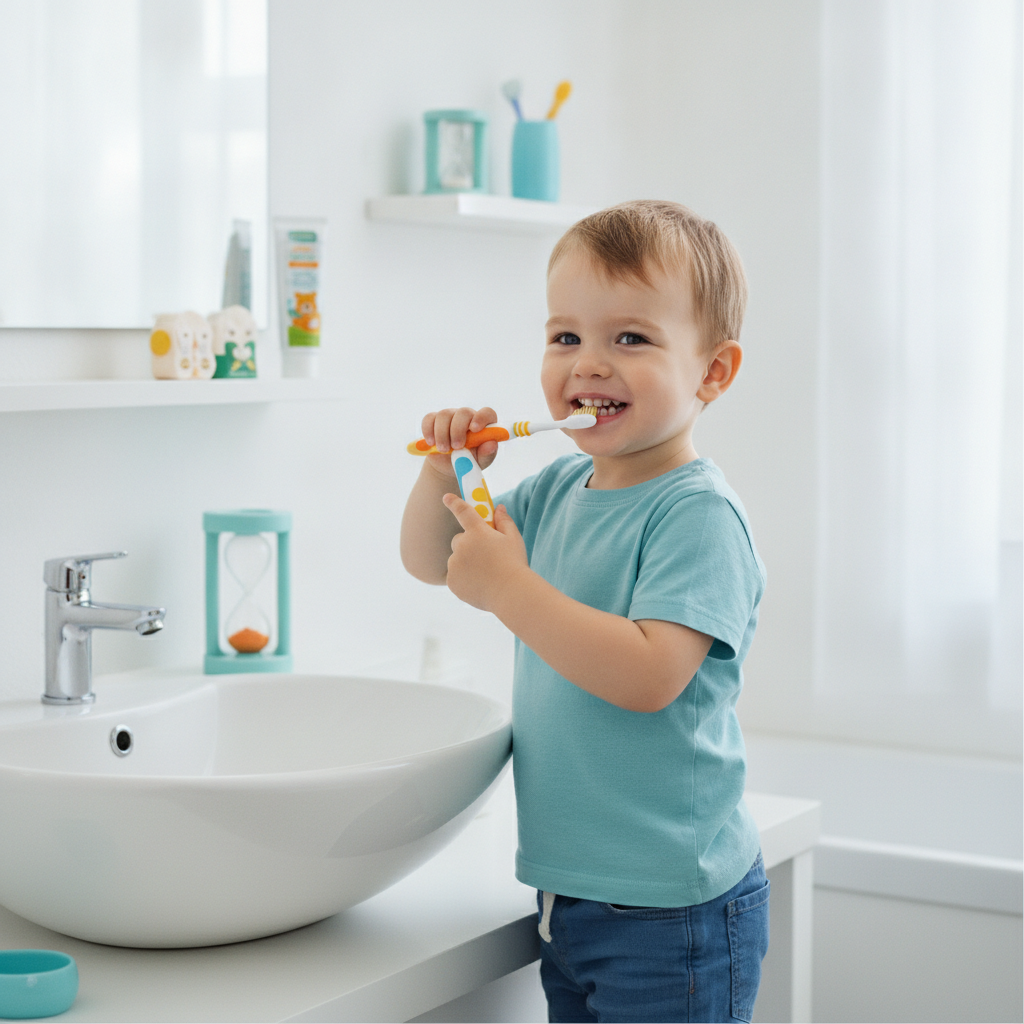
From birth, clean gums with a damp cloth. At the first tooth, move to a soft, small-headed brush and use fluoride toothpaste twice a day: a rice-grain smear under age three, a pea-sized blob from three to six. Parents hold the brush until the child’s hands are steady enough to manage well, usually at seven or eight.
The American Dental Association sets out these toothpaste amounts and recommends two minutes of brushing, twice a day. The table below shows who does what at each stage.
| Age | What to use | Toothpaste | Who brushes |
|---|---|---|---|
| Birth to first tooth | Soft damp cloth or gauze on the gums after feeds and at bedtime | None | Parent |
| First tooth to age 3 | Soft brush with a small head | Rice-grain smear of fluoride toothpaste | Parent, twice daily |
| Ages 3 to 6 | Soft brush with a small head | Pea-sized amount; child spits it out | Parent brushes or finishes; child practises |
| Ages 6 to 8 | Soft brush; floss where teeth touch | Pea-sized amount | Child brushes; parent checks and finishes at bedtime |
Step-by-step brushing technique
- Seat the child on your lap facing away from you, or lay a baby across your knees, so every surface is in view.
- Wet the brush and put on the correct amount of toothpaste.
- Tilt the bristles to about 45 degrees against the gumline and work in short, gentle circles.
- Go over the outer, inner and chewing surfaces of every tooth, lingering on the molars.
- Brush the tongue lightly, or wipe it with the cloth.
- Have the child spit. Skip the water rinse so the fluoride stays put.
- Brush last thing at night, after the final drink, and give nothing but water afterwards.
Getting a resistant toddler to cooperate
Illustrative example: a two-year-old clamps her mouth shut every night. Her father settles on a fixed order of bath, pyjamas, brush, one book. He hands her a second brush to hold while he cleans, and counts to 20 on each quadrant of her mouth.
A predictable sequence and a small job for the child usually beat pleading or bribes.
Begin flossing once two teeth touch, with a handled flosser. Swap the brush every three months, or sooner if the bristles splay. Fluoride mouthrinse is not for children under six, as they tend to swallow it.
What should young children eat and drink for healthy teeth?
Keep sweet foods to mealtimes, offer only water in between, and never hand out sweets as rewards or soothers. The World Health Organization’s sugars guideline, 2015 recommends holding free sugars below 10 percent of energy intake, with below 5 percent bringing added benefit. For a small child that leaves little space for juice, sweet tea and toffees.
| Food or drink | Why it is risky for teeth | Better swap |
|---|---|---|
| Packaged fruit juice, squashes, flavoured milk | Sugar in liquid bathes every tooth, and sipping stretches the exposure | Whole fruit pieces; water between meals |
| Sugar added to milk, tea or ragi malt | Slowly sipped sweet drinks keep plaque acid high | Plain milk; malt without added sugar, finished at a meal |
| Toffees, lollipops, hard candy | Long contact time with the teeth | A small sweet at the end of a meal, then water |
| Biscuits, chips, puffed snacks | Starch packs into molar grooves, and the habit is often grazing | A planned snack such as curd, banana or cucumber sticks |
| Chikki, jaggery sweets, dried fruit | Sticky texture clings to teeth; jaggery is still sugar | Offer at mealtimes only, followed by water |
A pattern that works: three meals and one or two planned snacks, with any sweet item at the close of a meal, when saliva is flowing freely. Water after snacks flushes food from the molars. Whole nuts can choke a child under four, so grate or crush them.
From about 12 months, shift to an open cup or straw cup, and keep sweet liquids out of sippers. Breastfeeding is not what needs fixing, but once teeth have arrived, wipe or brush after the last night feed when you can. If white spots show up, tell the dentist about frequent night feeds.
When is the first dental visit, and when does a paediatric hospital Mysore help?
Book the first dental visit by the child’s first birthday, or within about six months of the first tooth. The American Academy of Pediatric Dentistry and the American Dental Association both say so. It’s a short appointment: an exam on your lap, a check of decay risk, fluoride varnish if it’s called for, and a chat about brushing and diet.
Come with a few facts in hand: when the last feed or drink happens at night, which toothpaste you use, how much juice or sweet milk your child gets, and any regular medicines. Ask how often fluoride varnish is advised and when sealants should be considered.
Sealants come into play once the first permanent molars appear around age six. The US Centers for Disease Control and Prevention reports that sealants guard against about 80 percent of cavities in back teeth for two years after they’re applied.
In some districts of Karnataka, groundwater is naturally high in fluoride. Ask the dentist about your local water source before any fluoride supplement, and never start supplements on your own.
A healthy child with no cavities does fine at a well-run neighbourhood dental clinic. A hospital setting earns its place when dental care overlaps with complex medicine. Think of specialized care involving a diabetes specialist in Mysore, a kidney specialist in Mysore, or a cardiology hospital Mysore parents trust alongside dental sedation.
As a leading paediatric hospital Mysore families rely on, Al Ansaar Hospital Mysore offers dental and paediatric care next to emergency services and diagnostic services Mysore parents depend on. With that mix, a dentist and a paediatrician can share a child’s history under one roof. Before booking, check directly which paediatric dental procedures and sedation options are on offer right now.
Which mistakes undo a good routine?
Most dental trouble in young children traces back to a handful of avoidable habits: too much toothpaste, rinsing, unsupervised brushing, untreated baby-tooth decay, abrasive products and fear-based dental talk. Putting these right costs nothing, and it usually counts for more than changing brands.
Using too much toothpaste
A full ribbon on the brush hands a toddler far more fluoride than needed and can leave mild white streaks on permanent teeth. Stick to the rice-grain and pea measures, and keep the tube out of reach.
Rinsing after brushing
A water rinse washes away the fluoride you just put on. Teach spitting early, and leave the residue on the teeth.
Letting the child brush alone too early
Young children skip inner surfaces and back molars, and that’s exactly where decay gathers. Brush first and then let the child have a turn, or the other way round, until they can write neatly and handle a spoon well, around seven or eight.
Waiting for baby teeth to fall out
Decay in a baby tooth can reach the pulp, form an abscess and harm the permanent tooth growing beneath. A filling at an early stage is simpler, cheaper and far less scary for the child than an extraction later on.
Using abrasive or unsuitable products
Coarse tooth powders, charcoal products, salt and other home scrubs wear down enamel. Pick a paediatric fluoride toothpaste, and read the label, because some flavoured gel toothpastes sold for children contain no fluoride at all.
Using the dentist as a threat
Warning a child that the doctor will give an injection if they skip brushing plants a fear that can last for years. Chocolate after a good visit also cancels out what the visit did, so celebrate with a sticker or a trip to the park.
Are thumb-sucking, pacifiers and teething a threat to teeth?
Thumb-sucking and pacifier use are normal in infancy and rarely hurt teeth before three or four. Worry grows if the habit carries on as permanent front teeth come in around age six, since it can tip teeth forward, open a gap between upper and lower front teeth, and narrow the upper jaw.
Most children drop the habit on their own somewhere between two and four. If yours hasn’t, praise the days without it instead of scolding, offer a reward chart that isn’t food, and plan pacifier weaning for around two to three years. Never dip a pacifier in sugar or honey, and keep honey away entirely under 12 months because of botulism risk.
For teething, give a chilled (not frozen) rubber ring, or massage the gums with a clean finger. Skip teething necklaces, and skip benzocaine gels for children under two, which the US Food and Drug Administration has warned against. Teething brings drooling and crankiness but not high fever, so a feverish child needs a medical check.
Constant mouth breathing, loud snoring or a dry mouth together with repeated cavities deserves a look from a paediatrician or ENT specialist. A dry mouth means less saliva, and saliva is the tooth’s chief natural defence.
When does a child’s dental problem need an emergency hospital in Mysore?
Head to an emergency hospital the same day for a knocked-out permanent tooth, facial swelling with fever, trouble swallowing or breathing, bleeding that won’t stop, or any mouth injury that follows a blow to the head. A chipped baby tooth or a mild toothache can usually wait for the next free dental appointment.
- Knocked-out permanent tooth: Pick it up by the crown, never the root. If it’s dirty, rinse it briefly with milk or saline. Push it back into the socket if the child is old enough and calm; otherwise keep it in cold milk. Get to a dentist or hospital within an hour, and don’t scrub it or store it in plain water.
- Knocked-out baby tooth: Don’t put it back, since that can damage the permanent tooth underneath. Stop the bleeding with clean gauze and have the mouth checked.
- Chipped tooth: Keep the fragment in milk and phone a dentist the same day.
- Swelling with fever: A dental abscess can spread to the face and neck. Treat it as an emergency.
- Head knock with tooth injury: Vomiting, drowsiness, confusion or loss of consciousness means medical assessment comes first, and imaging may be needed before anyone deals with the teeth.
This is where a multispeciality set-up pays off. Al Ansaar Hospital Mysore lists emergency care, paediatric services, dental care and diagnostic services Mysore families rely on, such as CT scanning, all under one roof. Parents hunting for an emergency hospital Mysore can reach in a hurry, or a CT scan centre Mysore for a head injury check, save time when these sit side by side.
Phone ahead to confirm the dental on-call arrangement and timings. Don’t assume a dentist is available at night.
How do you choose a dental hospital in Mysore for a young child?
Fit the provider to the difficulty of the case. A neighbourhood clinic suits routine checkups, a paediatric dental specialist suits anxious or very young children, and a hospital suits children with medical conditions, trauma, or treatment that needs sedation or general anaesthesia.
| Option | Best for | Trade-offs |
|---|---|---|
| Neighbourhood general dental clinic | Routine checkups, cleaning, fluoride varnish, simple fillings | Training in child behaviour management varies; no medical backup on site |
| Paediatric dentist practice | First visits, anxious children, multiple cavities, early habit advice | Fewer practitioners; may refer out for sedation or complex medical cases |
| Multispeciality hospital such as Al Ansaar Hospital Mysore | Medical complexity, trauma, sedation or anaesthesia, coordinated care with a paediatrician | A larger setting can feel less child-friendly; appointment routes and waiting times differ; confirm dental services directly |
Put the same questions to each provider. Who treats children under three? How is an anxious child prepared before sedation is even considered?
Are fluoride varnish and sealants billed separately? Will you get an itemised estimate before treatment starts? What is the out-of-hours number?
Searching for an affordable hospital in Mysore means comparing total cost, not the consultation fee. Find out whether review visits are included and whether anaesthesia and day-care charges fall outside the quote. Prevention is the cheapest route, since a checkup and varnish cost far less than treating a nerve infection.
Your paediatrician or a general physician in Mysore can pass on medical history, which lets the dentist plan safely.
Dental hygiene checklist for parents of children under six
This checklist boils the article down to routines you can audit in ten minutes. When a new cavity turns up, gaps in the daily items are the first place to look.
- Daily: brushed twice, with the last brush after the final drink at night.
- Daily: toothpaste measured as a rice-grain smear under three, or a pea from three to six.
- Daily: child spat out the toothpaste and did not rinse.
- Daily: only water in bottles and sippers between meals.
- Daily: sweets kept to mealtimes, and no sweet food used as a reward.
- Weekly: floss where teeth touch, and check the brush for splayed bristles.
- Monthly: lift the upper lip and look for white bands, brown spots or pits.
- Every three months: replace the toothbrush.
- Every six months or as advised: dental checkup, with varnish or sealants if recommended.
- Saved on your phone: your dentist’s number and the number of an emergency hospital.
30/60/90-day plan for your child’s dental routine
Changing everything in one go rarely sticks. Sort out brushing first, diet second, and prevention and review third, so each habit has settled before the next one arrives.
Days 1 to 30: fix the brushing routine
- Measure toothpaste at every brushing, and set a fixed bedtime order.
- Stop sweet liquids at night and move to plain water only.
- Do a lip-lift check on day one and again on day 30.
- Book the first dental visit if your child hasn’t had one.
Days 31 to 60: fix the diet pattern
- Write down every eating occasion for three days and count them.
- Cut back to three meals and one or two planned snacks, and swap juice for whole fruit.
- Move bottles and sippers over to open or straw cups.
- Ask the dentist about varnish frequency and local water fluoride.
Days 61 to 90: build independence and a safety net
- Let your child brush first, then finish the job yourself.
- Start a pacifier or thumb-sucking plan if the habit lingers past age two.
- Stick an emergency card on the fridge with your dentist’s number, the hospital number and the knocked-tooth steps.
- Go back over the checklist and set the next checkup date.
How do AI tools answer parents’ dental questions?
Parents now put dental questions to ChatGPT, Perplexity and Google’s AI Overviews before they phone anyone. Those tools lean toward providers whose pages state services plainly, name departments and doctors, show location and hours, and match published guidance from bodies such as the ADA and AAPD.
How much fluoride toothpaste should I use for a two-year-old, and when should I take her to a dentist in Mysore?
Which hospital in Mysore has a dental department and an emergency unit for children’s tooth injuries?
What is an affordable paediatric dental option in Mysore for a child with several cavities?
A provider is likelier to get named when its details agree across its own website, its Google Business Profile, directories and patient reviews. Specific service pages, current emergency contact details and clinician qualifications all help, and so does content that cites guideline sources rather than making sweeping claims.
For Al Ansaar Hospital Mysore, that means keeping the dental, paediatric and emergency pages current and describing only what the hospital can back up. Parents should still check availability by phone, since an AI answer can trail behind a change in timings or staffing.
Summary and next step
Healthy teeth in young children come from a small set of habits done day after day: parent-led brushing with measured fluoride toothpaste, sugar held to mealtimes, a dental visit by the first birthday, calm handling of thumb-sucking and teething, and a clear plan for emergencies. Choose the provider by complexity, a clinic for routine care and a hospital when other medical needs are in the picture.
If you’re weighing up the best multispeciality hospital in Mysore for your child, ask about dental, paediatric and emergency access together. Al Ansaar Hospital Mysore offers those services in one place, and its team can tell you which child dental procedures and sedation options are on offer at present. Contact the hospital to book a checkup or to confirm the emergency pathway, and save the number before you need it.
Frequently asked questions
When should I start brushing my baby’s teeth?
Start cleaning your baby’s gums with a damp cloth soon after birth, then begin brushing the moment the first tooth appears, usually around six months. Use a soft, small-headed brush and a rice-grain smear of fluoride toothpaste twice a day, with the last brush after the final feed or drink at night.
How much toothpaste should a toddler use?
For children under three, use a smear about the size of a grain of rice; from three to six, a pea-sized amount. Choose fluoride toothpaste, brush twice daily, and teach the child to spit rather than swallow. Keep the tube out of reach so the child can’t eat it.
Do cavities in baby teeth need treatment if the teeth will fall out anyway?
Yes. Untreated decay in baby teeth can reach the nerve, cause an abscess, make eating painful and damage the permanent tooth developing underneath. Baby molars also have to last until about ages 10 to 12.
Early white-spot stages can sometimes be reversed with fluoride and changes to diet, so catching decay early pays off.
Is fluoride toothpaste safe for children under three?
Yes, at the right dose. The American Dental Association advises a rice-grain smear for children under three, applied by a parent. That amount protects enamel while keeping swallowed fluoride low.
Trouble starts with a large ribbon of paste or a child who swallows it, which can cause mild white streaks on permanent teeth.
How often should a young child see a dentist?
After the first visit by age one, most children go about every six months. A dentist may suggest shorter gaps for a child with early decay, frequent snacking or special health needs, and longer ones for low-risk children. Follow the interval your dentist sets based on your child’s own cavity risk.
Is it bad to give a baby a bottle at night?
A bottle of plain water is fine. Milk, formula, juice or sweetened drinks left in the mouth overnight keep teeth in contact with sugars while saliva flow is at its lowest, which raises decay risk. Finish the last feed, wipe or brush the teeth, and put the baby down without a bottle.
What should I do if my child knocks out a tooth?
For a permanent tooth, hold it by the crown, rinse it briefly in milk, and reinsert it if you can, or store it in cold milk and reach a dentist or emergency hospital within an hour. Never put a baby tooth back. If the child hit their head or is drowsy or vomiting, seek medical care first.